5 Steps How to Deploy AI Solutions for Recruitment and Shorten Placement Times
In short
Answer summary for readers and AI search
UK recruitment agencies can shorten placement times by auditing candidate journeys, adding 24/7 conversational AI screening, connecting ATS and CRM workflows, using RAG-based internal sourcing and optimising with sentiment data.
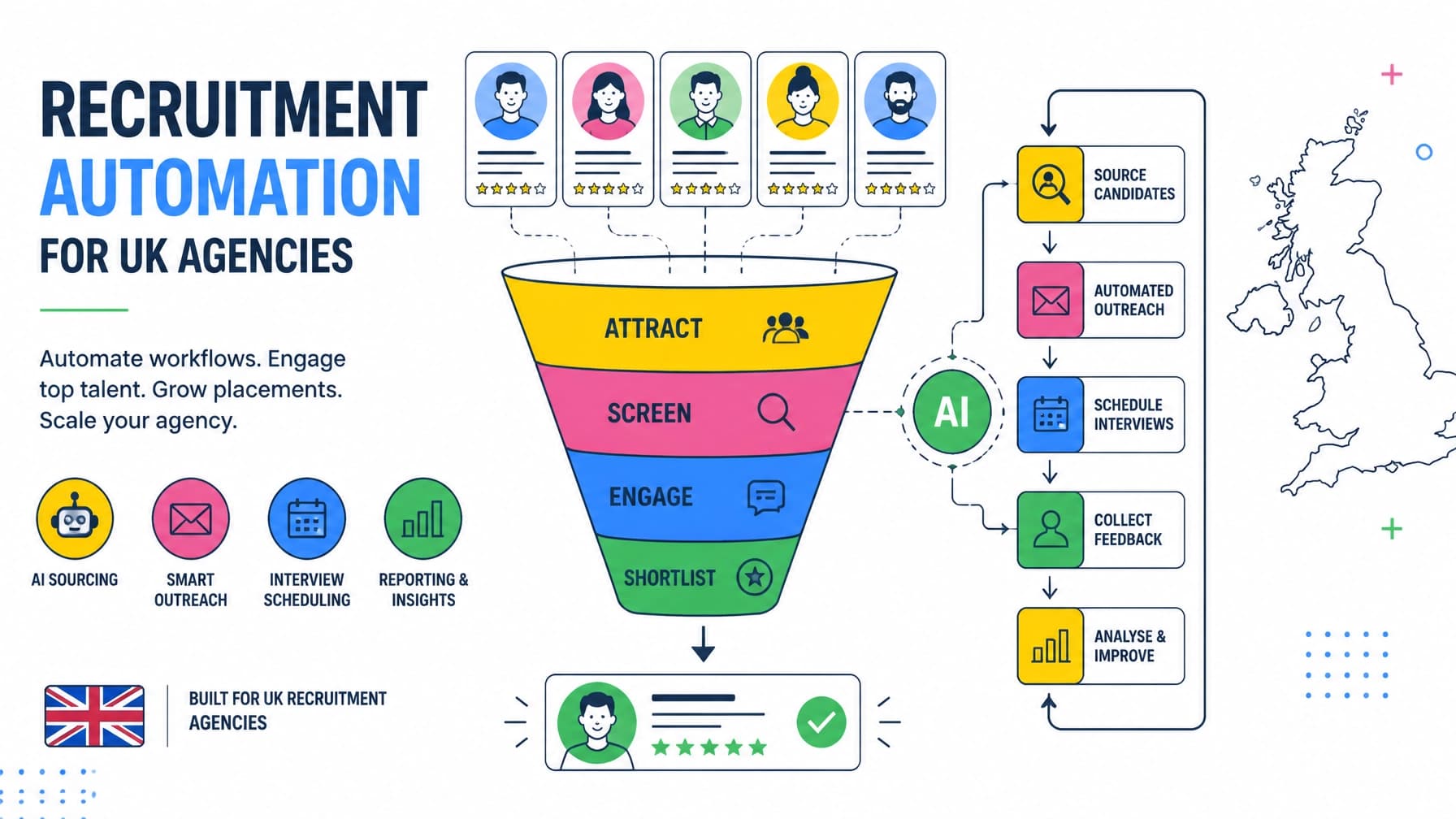
In Short: UK recruitment agencies are currently losing up to 40% of their billable hours to manual screening, CV formatting, and data entry. In 2026, high-performing agencies are shifting to AI-driven workflows that automate candidate matching, initial screening, and CRM updates. By deploying custom AI agents and integrated RAG pipelines, agencies can reduce time-to-placement by 30-50% while maintaining a 98% candidate satisfaction rate. The key is a phased implementation starting with high-friction tasks like screening and outreach.
The Recruitment Bottleneck: Why "Business as Usual" is Failing
The recruitment industry in the UK is facing a paradox. There is no shortage of talent or roles, yet the time-to-hire remains stagnant. Most agencies still rely on recruiters manually scanning hundreds of CVs, chasing candidates for initial screening calls, and fighting with their ATS (Applicant Tracking System) to keep records clean.
This "manual heavy lifting" doesn't just slow down placements; it creates a poor experience for candidates and clients alike. When a recruiter spends four hours a day on admin, they aren't building relationships. A recruitment agency isn't a database; it’s a matching engine. If the engine is manual, it’s already obsolete.
At Pyxage, we’ve seen this first-hand. We’ve helped businesses save over 10,000 manual hours by replacing these bottlenecks with intelligent AI automation systems.
Here are the 5 steps to deploying AI in your agency to shorten placement times and reclaim your team's time.
Step 1: Audit and Map Your Candidate Journey
Before you buy a single AI tool, you need to know where the friction is. Most agencies assume they need "better sourcing," but the reality is usually a leaky funnel during the screening or onboarding phase.
Direct Directive: Map every touchpoint from the moment a candidate applies to the moment they are placed. Identify where human recruiters are doing repetitive, low-value work.
- Common friction points: Initial eligibility checks, scheduling interviews, and CV formatting for client submissions.
- The Goal: Eliminate any task that doesn't require high-level human negotiation or emotional intelligence.
Step 2: Implement Conversational AI for 24/7 Screening
The biggest delay in recruitment is the "chase." A candidate applies at 8 PM on a Friday; a recruiter calls them at 10 AM on Monday. By then, the candidate has often moved on.
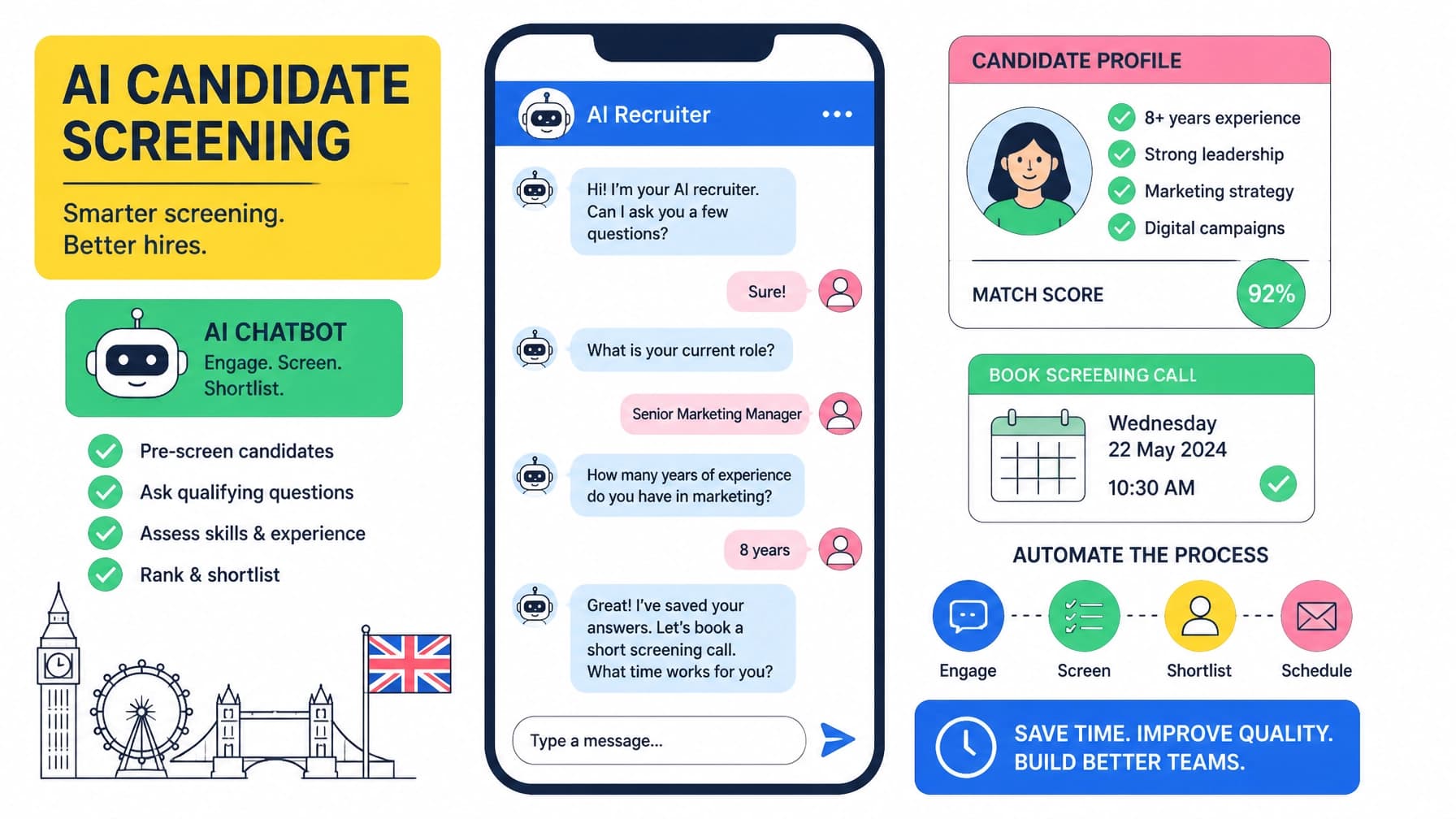
Deploying custom AI agents or chatbots handles this instantly. These aren't the generic, "click a button" bots of 2023. Modern AI agents can:
- Engage candidates in real-time, 24/7.
- Conduct initial screening based on specific job requirements (right to work, salary expectations, notice periods).
- Automatically book successful candidates directly into a recruiter’s calendar.
Step 3: Automate Workflow Pipelines (The CRM "Glue")
The most significant time-saver is connecting your tools. If your recruiters are manually moving data from LinkedIn to your ATS (like Bullhorn or Vincere), you are wasting money.
Our workflow automation services focus on building a seamless pipeline. When a candidate passes an AI screening, the automation should:
- Update the CRM record instantly.
- Generate a formatted "Candidate Summary" for the client.
- Trigger a Slack or Email notification to the account manager.
The result? A 70% reduction in "administrative lag" between stages.
Step 4: Deploy RAG-Based Internal Sourcing
Most agencies have a goldmine of data in their existing database, but it's "dark data": impossible to search effectively. Standard keyword searches often miss the best candidates.
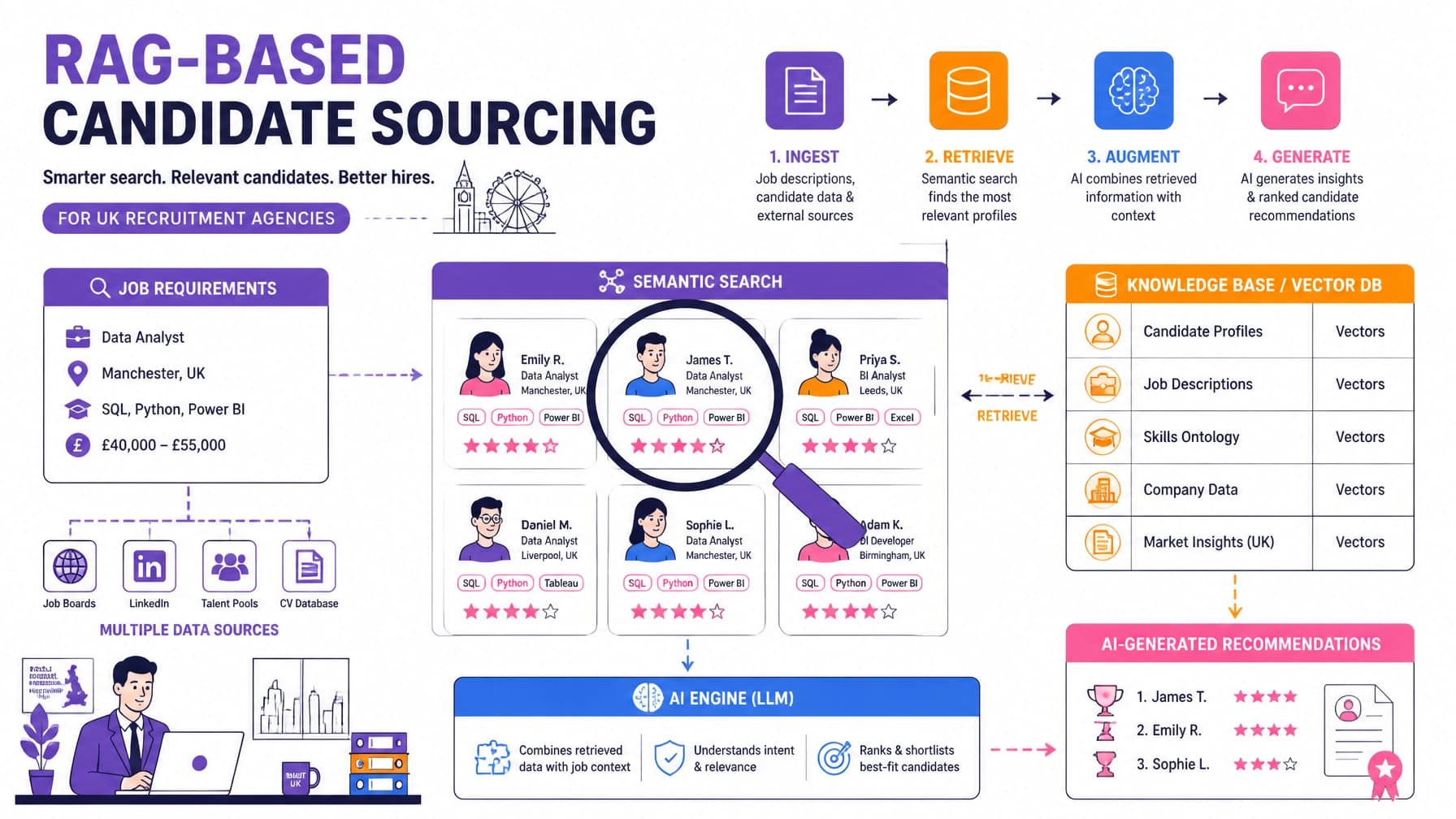
By using Retrieval-Augmented Generation (RAG), we build custom search layers over your existing database. Instead of searching for "Project Manager + Prince2," a recruiter can ask the AI: "Find me candidates with experience leading mid-sized tech teams who are likely to be looking for a role based on their last update."
The AI understands the context and intent, not just the keywords. This turns your internal database into your most powerful sourcing tool, bypassing expensive external job boards.
Step 5: Continuous Optimization with Sentiment Analysis
AI deployment isn't a "set and forget" project. To truly shorten placement times, you need to listen to the data.
Advanced AI solutions can analyze candidate-recruiter interactions (via email or call transcripts) to identify sentiment. Are candidates dropping out at the same stage? Is a particular client’s onboarding process causing friction?
Direct Directive: Use AI-generated insights to refine your screening questions and outreach templates every month.
Technical Foundation: The Architecture of a Modern Agency
At Pyxage, we don't just "plug in" a bot. We build a technical foundation that ensures your data is secure and your processes are scalable.
The architecture typically involves:
- Semantic Search Layer: Using vector databases to enable contextual searching across CVs and job descriptions.
- API-First Integration: Connecting your ATS, email (Outlook/Gmail), and communication tools (WhatsApp/SMS) via secure API pipelines.
- Headless CMS/Frontend: If you are a high-volume agency, we often deploy high-converting websites with AI-enhanced UX that capture and qualify leads before they even hit your inbox.
- Compliance Guardrails: Ensuring all AI interactions are GDPR compliant and ground responses in your agency's verified data (Grounding).
A recruitment process isn't just a series of calls. It's a data pipeline. If the pipeline is clogged with manual tasks, your business can't scale.
The Pyxage Advantage for UK Agencies
Located in Dorset, we work closely with recruitment firms in Weymouth, Dorchester, and Portland, as well as agencies across the UK. We understand the local market and the specific challenges of the UK recruitment landscape.
- Measurable Results: We’ve helped clients achieve a 340% increase in screening efficiency.
- Practical Implementation: We don't deliver "hype." We deliver systems that your team will actually use.
- Bilingual Capability: Our systems can handle both English and Romanian, perfect for agencies working with international talent pools.
FAQ: AI in Recruitment
Will AI replace my recruiters?
No. AI replaces the boring parts of recruitment. It handles the screening, data entry, and scheduling so your consultants can focus on what they do best: negotiating deals and building relationships.
How long does it take to implement?
A standard AI agent and workflow automation setup typically takes 2 to 4 weeks from the initial audit to launch. We focus on a "crawl, walk, run" approach to ensure your team isn't overwhelmed.
Is my candidate data secure?
Absolutely. We use enterprise-grade encryption and ensure all AI models are "grounded" in your private data. Your data is never used to train public models.
What if the AI makes a mistake during screening?
We implement human-in-the-loop (HITL) protocols. The AI flags "edge cases" or candidates who are a partial match for a human recruiter to review, ensuring you never miss out on top-tier talent.
Next Steps: Is Your Agency Ready for 2026?
The gap between AI-enabled agencies and manual ones is widening every day. Agencies that automate now are the ones that will dominate the market by 2026.
Don't guess: audit. We offer a free AI audit for recruitment agencies to identify exactly where you can save time and increase placements.
[Book Your Free AI Audit & Architecture Session](https://www.pyxage.com/contact)
Need AI automation for a recruitment agency?
Pyxage designs AI agents, ATS workflows and RAG search layers that reduce manual screening, admin lag and missed candidate follow-up.
View relevant serviceRelated articles
Building Custom AI Agents That Actually Transform Business Operations
Learn how purpose-built AI agents handle support, sales, and internal operations around the clock with measurable ROI.
Workflow AutomationWorkflow Automation: Building Intelligent Pipelines That Connect Your Entire Business
Learn how end-to-end process automation connects your tools into one seamless, intelligent pipeline that scales.
Websites & Landing PagesHow AI-Enhanced UX Is Redefining High-Converting Websites in 2026
Discover how AI-driven personalization and modern frameworks are transforming static websites into dynamic conversion engines.
Frequently asked questions
What should recruitment agencies automate first?
Start with repeated high-friction tasks such as initial eligibility checks, candidate screening, interview scheduling, CRM updates and candidate summaries.
Can AI reduce time-to-placement?
Yes. AI can reduce delays by responding instantly, qualifying candidates consistently, surfacing database matches faster and removing manual handoffs between systems.
How do you keep recruitment AI safe and compliant?
Use grounded data sources, GDPR-aware workflows, human-in-the-loop review for edge cases, audit logs and clear escalation rules.
Ready to automate?
Book a free AI discovery audit and find out how we can transform your operations.
Book your free consultation